Showing posts with label language learning. Show all posts
Showing posts with label language learning. Show all posts
5.10.19

2.10.19
The secrets of learning a new language
This is the video you have to watch to answer the questions in the photocopy.
31.1.19
Learning a language
 Click here to listen to a man talking about learning languages. This is one of the activities we did in class (I wanna talk about learning languages).
25.1.19
Learning a language
 When you first start learning a new language, it might seem frustrating. There are tons of new vocabulary words and new grammar rules to learn, and listening to native speakers may make your head spin.
But don’t give up! You successfully learned one language well so far (or you wouldn’t be understanding this post!), so you can clearly learn another. And the fact that you’re even reading this article shows me another important factor — that you’re motivated to learn!
Outside of that, though, some people seem to learn languages faster than others. More often than not, it’s because they possess certain traits and characteristics that help them along the way. I’ve been tutoring for a while now, so I started thinking about what these traits are.
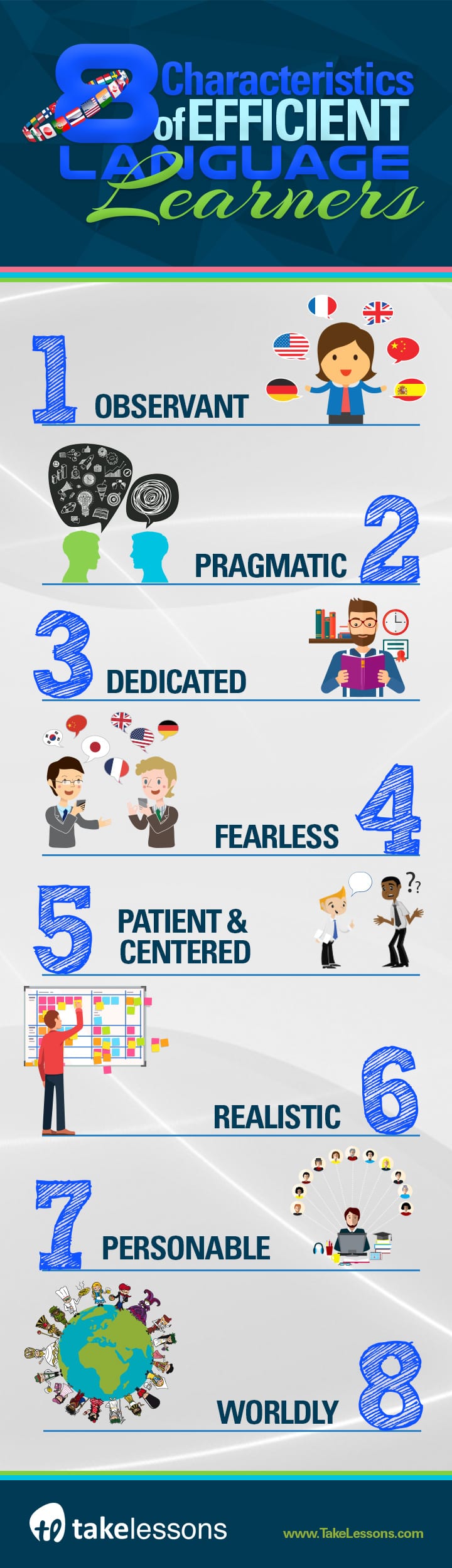
Here are the characteristics I see in my most successful language students:
The most effective language learners spend time and energy outside of classes and lessons trying to understand the language’s clues, patterns, structure, and organization. Along with this, you should keep notes to monitor what you’ve learned, and come prepared with questions for your tutor, teacher, or professor.
Learning Tip: As you learn, immediately apply new words and grammatical concepts/rules by writing or speaking. You’ll likely already be doing this with your tutor, but continue practicing in between your lessons, too. Pay attention to contextual clues as you speak with others, and write down any patterns you notice.
2) Pragmatic
My best students know what works and what doesn’t for their personal learning style. This includes an active approach in tailoring your personal preferences and needs in all learning situations, so you don’t waste time on what is ineffective for you.
My best students know what works and what doesn’t for their personal learning style. This includes an active approach in tailoring your personal preferences and needs in all learning situations, so you don’t waste time on what is ineffective for you.
This characteristic also involves thoughtfulness, including picking up on the objective of a given in-class exercise and why it’s important to your overall language learning.
Learning Tip: Figure out your learning style, and make sure your tutor knows it too.
3) Dedicated
Super-learners believe they can always learn something, even if they dislike or struggle with a given concept, topic, or rule. They steadfastly seek learning environments that facilitate their unique needs and goals.
Super-learners believe they can always learn something, even if they dislike or struggle with a given concept, topic, or rule. They steadfastly seek learning environments that facilitate their unique needs and goals.
They also know there are no shortcuts when it comes to learning! Efficient language learning requires a combination of a great teacher or tutor, the right learning resources, and a commitment to practicing on your own time.
Learning Tip: Supplement your lessons with other ways of interacting and learning. This could include taking an online group class, playing a language-learning game, or listening to a podcast during your commute to and from work or school.
4) Fearless
4) Fearless
My best students frequently seek out opportunities to chat with native or experienced speakers, with the aim of communicating and understanding before accurateness. Down the road, while temporarily prioritizing communication, super-learners know they will learn to balance communicating with accuracy as they improve.
Learning Tip: Don’t be afraid to leave your comfort zone! Seek out opportunities to chat with others, whether they’re native speakers or another student learning the same language.
5) Patient and centered
5) Patient and centered
Research has shown the best way to learn is with a relaxed, yet alert inner-posture. In my five years of experience as a tutor and 12 years as a Spanish language learner, I have seen that one’s attitude, including patience with the process, can be more important than your initial skill level and intelligence!
Learning Tip: If you’re feeling frustrated with your progress, take a step back. Learning a new language takes time, and some concepts and rules may seem easier than others. Let your tutor know if you’re struggling with something, and spend extra time on that.
6) Realistic
6) Realistic
Most languages are highly complex. Efficient language learners are realistic, systematic, and goal-oriented in their approach. The involves an active long-term commitment, effective organization, and knowing that it’s unrealistic to aim for perfection.
Learning Tip: Think about your short- and long-term goals, and write them down. Make sure they’re realistic and reachable! If you have a busy schedule, you may not have a ton of time to set aside — and that’s OK. Just make sure you’re noticing consistent progress, no matter how small.
7) Personable
7) Personable
As trait #4 mentioned, consistent contact with experienced and/or native speakers is key. Super-learners have the social support needed to continually practice the language, in all types of settings.
Learning Tip: Get as much practice as you can speaking in your target language! Chat with other students online, find a language exchange partner, or teach a family member what you’ve learned so far.
8) Wordly
8) Wordly
Lastly and most importantly, efficient language learning requires embracing the culture of the new language! They know that a language is much more than vocab and grammar; it’s an entirely new way of conceptualizing and seeing the world.
Learning Tip: If you have the resources, consider traveling to a country where the language is spoken. Immersion is proven to help you learn faster, as you’ll get real-life practice.
6.10.17
Apps and Websites to help you learn and practise
Four ways to get better at languages
Script:
Sometimes, when we're learning a language, we can feel very frustrated. Despite all the hours that we're putting in and all of the hard work that we're doing, when it comes to actually speaking the language, it can sometimes come out stuttered, full of mistakes, and sound like we're not really that good. This can lead to a lot of self-doubt. It can lead us to ask questions like: 'Can I really learn this language?' Or 'Have I perhaps reached my limit?'
The way to start speaking a language more fluently and more proficiently is just to practise speaking it. Practise, practise and practise again. Here are some tips that you can use to get more practice at speaking the language.
So, the first one is: Get a conversation partner. You can find a lot of people who will be happy to practise languages with you online. Or, otherwise, if you go to a meetup group or a student event, I'm sure you will find plenty of people who you can practise your languages with.
If you don't know where to find a conversation partner, the other thing you could do is start to talk to yourself. Or, if you're not comfortable talking to yourself in public, just think to yourself. Start narrating to yourself what you're doing and working out what things you're comfortable describing and what things you're not yet comfortable talking about. Then, when you go home, you'll be able to fill in those vocabulary gaps, and the next day try again.
[3. Learn vocabulary in phrases]
The third thing you can do is to learn vocabulary like you want to use it So, instead of just learning the word for 'door', why not learn it in a phrase like 'open the door', 'close the door' or 'behind the door'. That means that, when you need to talk about things like that, you're immediately going to have phrases that you can start using.
Finally, whenever you learn a new grammar point or anything really in the language, always think about how you could use this. Imagine a scenario in which you'd use it naturally, with friends, as part of your normal life, and then immediately you'll find that what you're learning theoretically will be much more applicable to your speaking of the language.
Subscribe to:
Posts (Atom)